Removable Dentures: The Guide to Partial Dentures (Stellite)
Removable dentures are devices intended to replace some or all of the missing teeth. They are easily removed for daily maintenance and make it possible to restore chewing, the harmony of the smile as well as the stability of the jaw. Function, variants, prices: a complete overview of partial and complete dentures.
What is a removable denture?
A removable denture is a device intended to partially or totally replace missing teeth, and which can be removed to ensure its daily maintenance. It restores chewing, speech and the aesthetic appearance of the smile, while offering a reversible solution adaptable to very diverse clinical situations.
The main categories of removable dentures are:
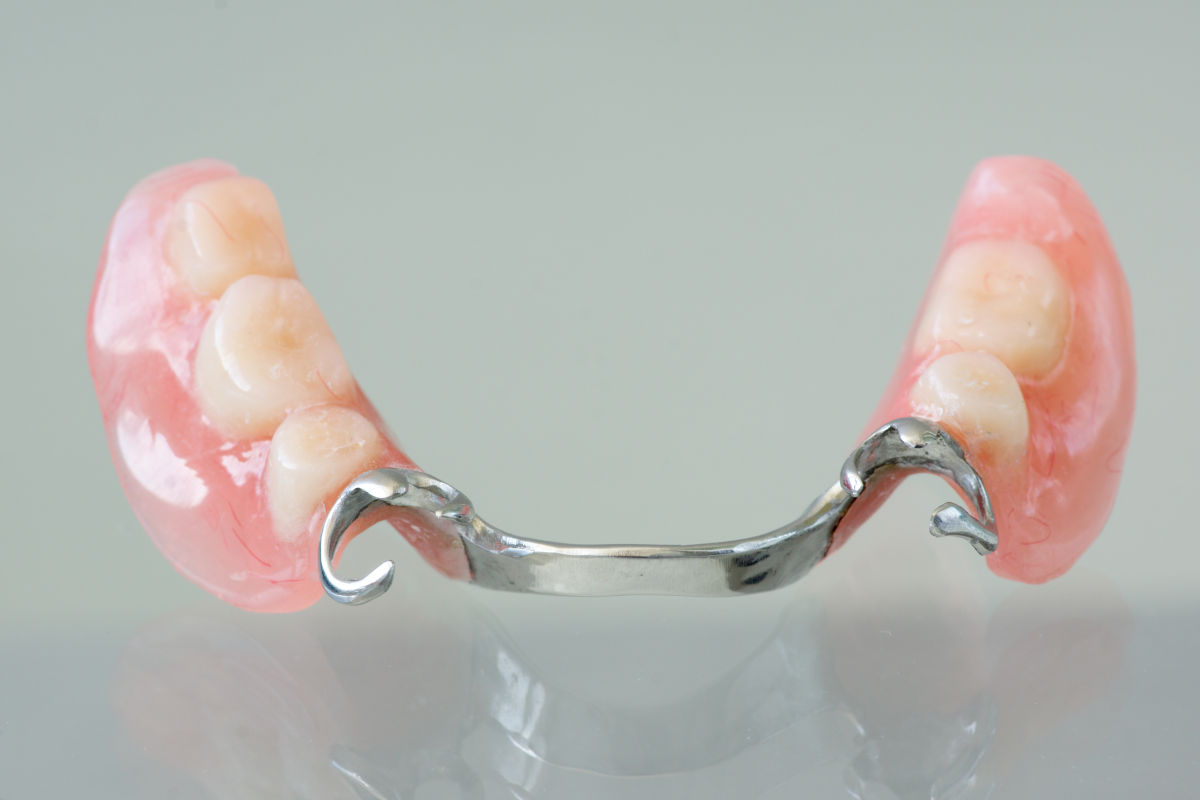
- Partial removable denture: only replaces a few teeth and rests on the natural teeth still present or crowned. The stellite is an example, with its metal framework and its resin or ceramic teeth.
- Complete removable denture: replaces all the teeth of a jaw. It is most often made of acrylic resin and can be stabilised on dental implants (All-on-4 or All-on-6 systems).
The choice of denture is made according to the clinical situation, the number of missing teeth, the comfort sought and the patient's budget.
What is the difference between a partial denture (stellite) and a full denture?
Each removable denture meets particular needs and stands out by its use and structure.
The stellite partial denture
The stellite partial denture is a removable partial prosthesis that replaces certain missing teeth. It rests on a precision metal framework, topped with resin or ceramic teeth fixed to the framework by a pink resin imitating the gum.
Stellites are held in place by clasps or attachments (without visible clasps) fixed on the natural teeth still present, knowing that at least two teeth are needed to install the device correctly.
What about stellites without clasps?
Certain partial removable dentures can be designed without visible clasps. We then speak of clasp-free stellites or aesthetic stellites. These devices use other fixation systems, such as invisible attachments or elements that clip onto crowned teeth.
The full denture
Conversely, the complete removable denture, or full denture, replaces the entire dentition of a jaw. It is generally made of acrylic resin and can, for greater stability, be fixed on dental implants thanks to an All-on-4 type system.
What are the materials used in removable dentures?
The manufacturing materials directly influence the solidity, aesthetics and comfort of the denture:
- Metal framework: used for stellites, both resistant and light, it allows precise adjustment on the teeth and mucous membranes.
- Pink resin: it imitates the gum and serves as a link between the teeth and the metal framework.
- Resin teeth: more economical and simple to adjust, they offer an acceptable aesthetic result but lower durability than ceramic.
- Ceramic teeth: very aesthetic, close to the appearance of a natural tooth, they resist wear better.
- Complete resin dentures: used for full dentures or for provisional appliances.
Each material is chosen according to the clinical situation and the comfort expected by the patient.
What are the advantages and disadvantages of a stellite denture?
Both light and solid, the stellite hooks onto the remaining teeth thanks to small clasps and makes it possible to compensate for the aesthetic and functional problems linked to missing teeth.
It has the advantage of being less bulky than traditional dentures, which favours better oral integration and more comfortable speech.
On a daily basis, several drawbacks may however manifest themselves in the wearer of a stellite: difficulties chewing and loss of taste of foods in particular. It can also favour bone resorption and weaken the abutment teeth on which it rests.
How does the manufacturing of a stellite or a removable denture proceed?
To carry out a stellite denture, the dentist first proceeds with a complete examination of the patient's mouth and treats any cavities. The practitioner may also choose to crown certain teeth in order to limit the risk of new cavities after the placement of the stellite.
An impression of the dentition is then taken and transmitted to the laboratory. The casting of the metal is carried out by a prosthetist, who scrupulously follows the layout defined by the dentist. The patient finally proceeds with the fitting of the stellite to check that it adapts perfectly to his dentition.
Nowadays, the stellite remains above all a default solution: dental implants or bridges should be favoured when their implementation can be considered.
What is the price of a stellite denture or a full denture?
The price of a removable denture varies according to the complexity of the dentition, the materials chosen and the work of the prosthetic laboratory.
- Stellite denture: between €1,200 and €2,500, depending on the number of teeth to be replaced and the quality of the laboratory.
- Full resin denture: between €900 and €1,800.
- Implant-supported denture (All-on-4): from €6,000.
A detailed quote is systematically provided before the start of the treatment, and the practice can support the patient in their reimbursement procedures with the relevant insurance schemes.
Partial removable denture VS complete removable denture: comparison table
| Type of denture | Main indication | Materials used | Retention | Average price |
|---|---|---|---|---|
| Stellite (partial) | Replacement of a few teeth | Metal + resin | Clasps on remaining teeth | €1,200 to €2,500 |
| Complete denture | Total loss of teeth | Acrylic resin | Rests on the gum | €900 to €1,800 |
| Implant-supported denture (All-on-4) | Complete replacement with fixed anchoring | Stellite fixed on crowns or attachment on implant – Complete resin appliance fixed by attachment on implant | Anchored in the bone | From €6,000 |
What is the lifespan of a stellite or a removable denture?
Well maintained, a removable denture lasts on average 5 to 10 years. Its longevity depends on maintenance, the material used and the regularity of check-up visits to the dentist.
It can, if necessary, be readjusted after a few years.
Is it painful to wear a stellite?
Placement is not painful, but slight discomfort or small irritations may occur during the adaptation phase. Adjustments remain possible to reach optimal comfort.
How to maintain a removable denture on a daily basis?
It should be removed every evening, brushed with a soft brush and immersed in a cleaning solution. It is also important to clean the gums and consult the dentist at regular intervals.
What are the advantages of an implant-supported denture compared to a stellite?
The implant-supported denture provides more stability, comfort and more efficient chewing. It slows down bone resorption and imposes no strain on the remaining natural teeth.
Can the aesthetics of a removable denture be personalised?
Yes. The shade of the teeth and the shape of the gum can be adjusted to the natural dentition for a harmonious and discreet result.