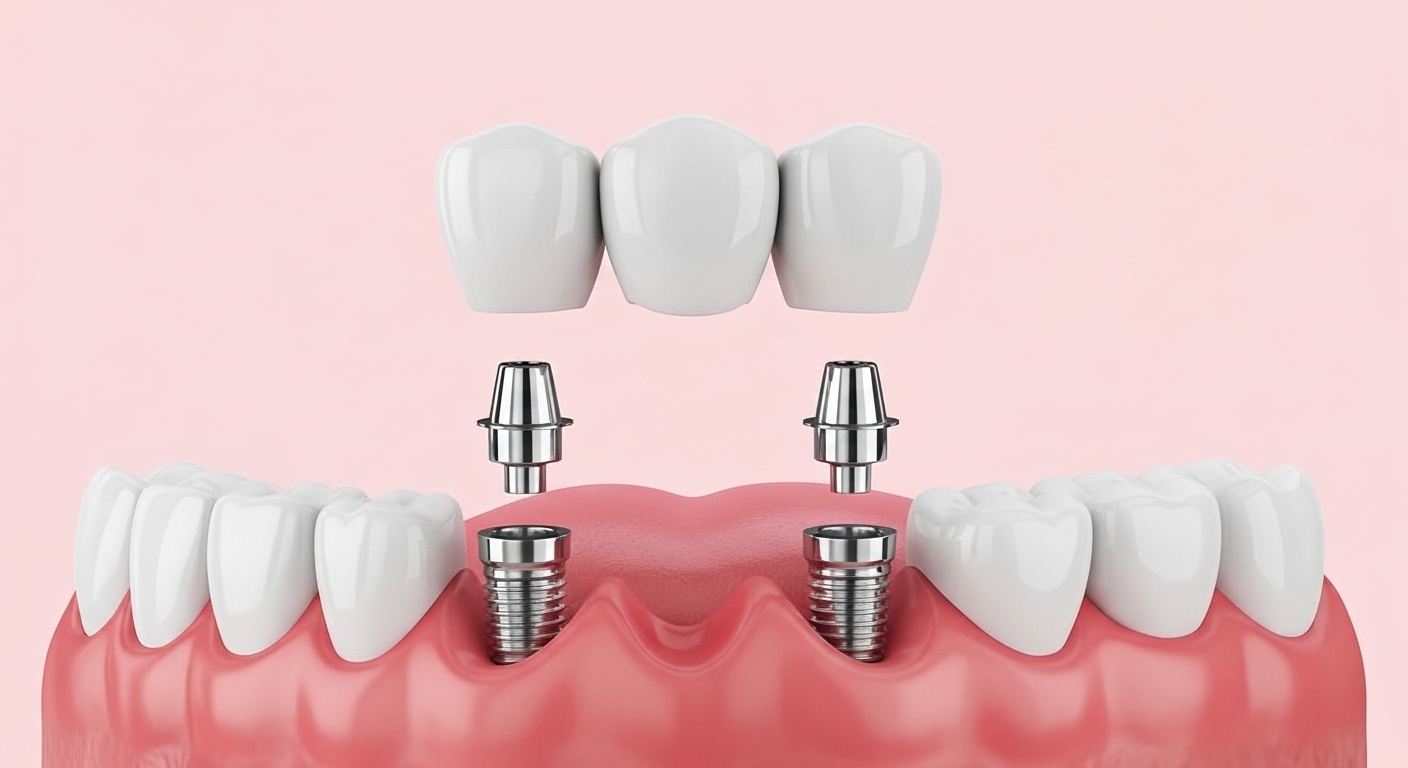
The Dental Bridge
Has one of your teeth suffered significant damage? Worse, have you lost it? This is an uncomfortable situation that is best remedied without delay. The dental bridge is a solution offered by your dental surgeon that can prove interesting in these scenarios.
What is a dental bridge?
To compensate for the loss of a tooth, your dental surgeon will probably offer you the placement of a dental prosthesis. The choice is then made between a dental bridge and a dental implant. If the implant is not indicated for various reasons (lack of bone, medical contraindication, economic reason), the dental bridge will then be the solution favoured by your dentist.
How does it work? The dental bridge is a prosthesis that rests on the two teeth that frame it. This system can make it possible to replace several teeth at once and has the advantage of being very aesthetic, because the difference between the prosthesis and the natural teeth is almost imperceptible.
The different types of bridges
There are several types of dental bridges. If you only have one or two teeth to replace, your dentist may offer you the placement of a bonded bridge (Maryland bridge). In this case, the bridge is a ceramic prosthesis fitted with metal wings on its sides. These wings rest on the adjacent teeth. The advantage of this solution lies in the fact that the abutment teeth are preserved in their integrity. Its main drawback is that, despite the progress made in the field, these prostheses tend to come loose and require careful monitoring.
Conventional bridges can be made from different materials. The most used are all-ceramic or zirconia (without metal infrastructure), or porcelain-fused-to-metal, in which the metal support is covered with several layers of ceramic, also offering a very aesthetic appearance. They are then used to replace posterior teeth and their use is avoided, deemed unaesthetic, on the anterior teeth. Others combine metal and ceramic. The latter are made entirely of ceramic and can only be placed in particular cases. Conventional bridges require more preparation of the adjacent teeth than bonded bridges. The dental surgeon is forced to reduce their size so that they can properly accommodate the dental prosthesis.
The placement of a dental bridge
How does the placement of a dental bridge go? It all depends on the type of bridge you have chosen:
For a bonded bridge, two appointments are enough at your dentist. The first allows for taking an impression and slightly preparing the neighbouring teeth if needed. The second is devoted to the placement of your prosthesis. The wings are fixed using an appropriate cement on the hidden faces of the adjacent teeth. The dentist then proceeds with the adjustments necessary for the aesthetics of your bridge.
A conventional bridge requires a little more work. During the first session, your dental surgeon prepares the neighbouring teeth. He carries out this step under anaesthesia if the teeth are still alive, or directly if they have already been devitalised. He then prepares their impression so that the prosthetist, with whom he collaborates closely, can manufacture the framework of your bridge. It is this framework that he tries on you at the next appointment. It must fit perfectly on your abutment teeth. If this is the case, he can install the entire prosthesis; otherwise, a new appointment will be scheduled.
Are you interested in the placement of a bridge and would you like to know if this type of prosthesis can suit you? Make an appointment at the dental practice in Cannes; the practitioner will be happy to answer all your questions.