The Purpose of Invisalign Attachments: Complete Guide
During your first Invisalign consultation, your practitioner likely mentioned "attachments." Far from representing a complication, these small composite bumps are actually one of the secrets to treatment success. They make complex tooth movements possible and are essential for achieving a perfect result.
What exactly are Invisalign attachments?
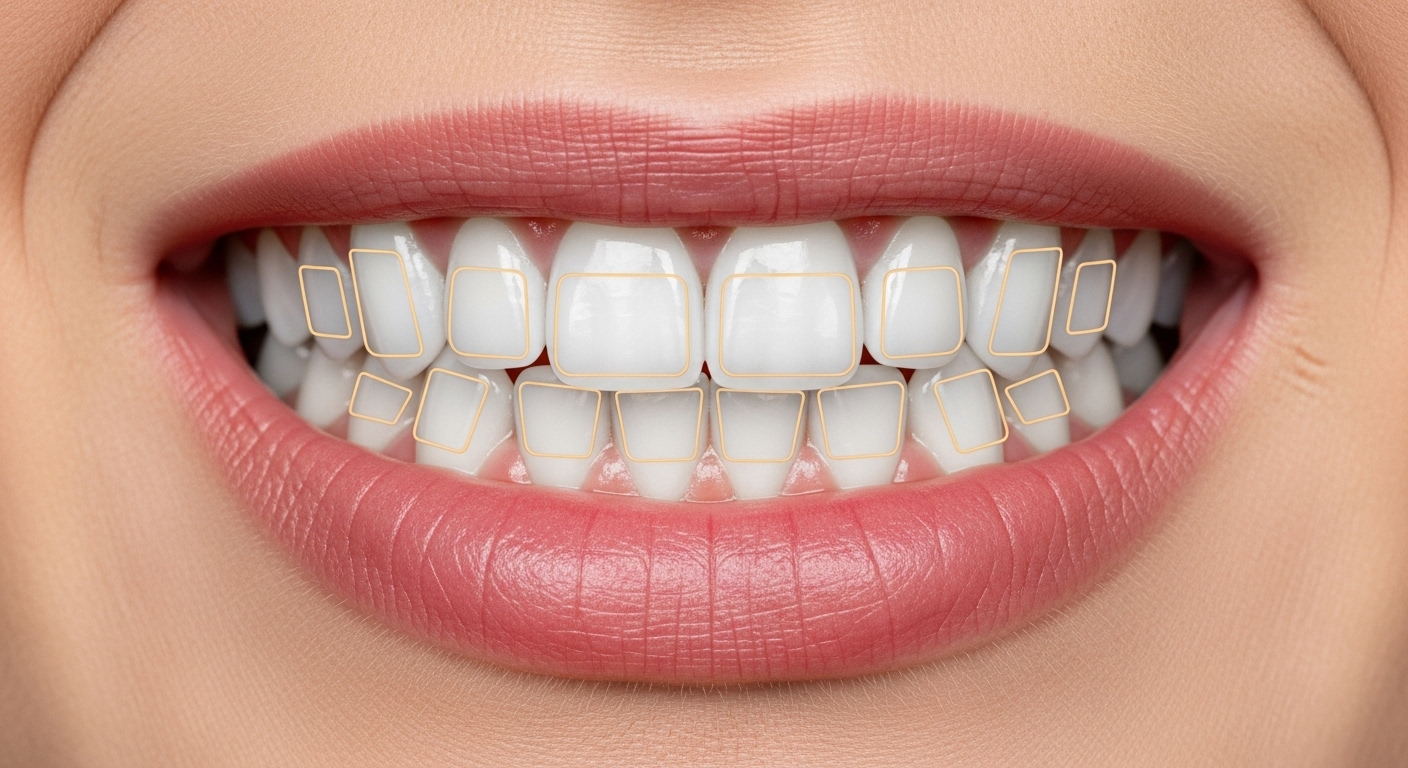
An attachment, also called a SmartForce® attachment, is a small raised bump made of composite resin (the same material used for "white" fillings) that matches your tooth color. It is temporarily bonded to the outer surface of certain teeth during treatment. These attachments can have different shapes and sizes (rectangular, square, circular...) depending on the type of movement to be performed.
What is the purpose of attachments?
Attachments function as "grips" or anchor points. They allow the aligner to have a better hold on the tooth to apply targeted forces with great precision. Without these bumps, the smooth surface of the tooth would not allow certain complex movements.
Their role is fundamental for:
- Performing rotations on poorly positioned teeth.
- Performing extrusions or intrusions (i.e., making a tooth "descend" or "rise").
- Controlling root movement of the tooth, not just its visible part (the crown).
- Optimizing the force transmitted by the aligner for a faster and more predictable result.
How are attachments placed?
Placing attachments is a simple, quick and completely painless procedure.
- The practitioner prepares the enamel surface to ensure perfect adhesion.
- They use a template, which looks like a special clear aligner with small receptacles.
- They fill these receptacles with composite in a fluid state.
- They position the template on your teeth, then use a curing light (blue light) to harden the composite.
- Once the template is removed, the attachments are firmly fixed to your teeth.
Frequently asked questions about Invisalign attachments
Are attachments visible?
Attachments are designed to be as discreet as possible. Being the same color as your teeth, they are difficult to notice. When wearing your aligners, they are virtually invisible. Without aligners, you will feel them with your tongue and they may be slightly visible up close, but much less than traditional braces.
What if I lose an attachment?
This can happen. Don't panic, it's not an emergency. Simply continue wearing your aligners as planned and contact your practitioner to report it. They will give you a quick appointment to rebond it. It's important not to wait too long, as the absence of an attachment can compromise the planned movement for the affected tooth.
When and how are attachments removed?
Attachments are removed at the end of the active phase of your treatment, just before taking impressions for your retainers. The practitioner uses a specific instrument to gently polish them, then cleans the tooth surface to remove all traces of composite. The procedure is quick, painless and absolutely does not damage your tooth enamel.
Conclusion: a major technological advantage for your treatment
Invisalign attachments should not be seen as a constraint, but rather as a major technological asset. They are proof that your treatment is fully personalized and optimized to achieve the best possible result. It's largely thanks to them that Invisalign can now treat increasingly complex alignment cases.
Ready to start your Invisalign treatment?
Find a certified Invisalign orthodontist near you with our interactive map of orthodontists in Cannes and the French Riviera.
Find an orthodontist