How to Get Straight Teeth: A Guide to Modern Solutions
A smile with straight, well-aligned teeth is a wish shared by many. Fortunately, contemporary orthodontics offers a range of solutions to correct dental malpositions at any age. Whether you're a teenager or an adult, a method suited to your needs and lifestyle exists.
Why aren't teeth always aligned?
Several reasons can explain why teeth grow in a disorderly manner or move over time. Identifying the origin of the problem is the first step to remedying it:
- Heredity: The correlation between jaw size and tooth size is often genetic.
- Childhood habits: Thumb sucking or prolonged pacifier use can influence tooth positioning.
- Loss of one or more teeth: The absence of a tooth can cause adjacent teeth to shift to fill the space.
- Orofacial dysfunctions: Poor tongue position at rest, mouth breathing or atypical swallowing can exert pressures that move teeth.
- Shock or trauma: An injury to the teeth or jaw can cause misalignment.
Main methods for aligning teeth
Today, adult orthodontics is a common practice offering more discreet and effective treatments than ever.
Traditional braces (multi-bracket)
This is the best-known technique. Brackets, made of metal or ceramic for more discretion, are bonded to the teeth and connected by a metal wire. It's a very effective solution for all types of corrections, including the most complex ones.
Lingual orthodontics
This method uses the same principle as traditional braces, but the brackets are fixed to the inner surface of the teeth, making them completely invisible. It's the most discreet option, but it's often more expensive and can cause tongue discomfort at the start of treatment.
Clear aligners (Invisalign type)
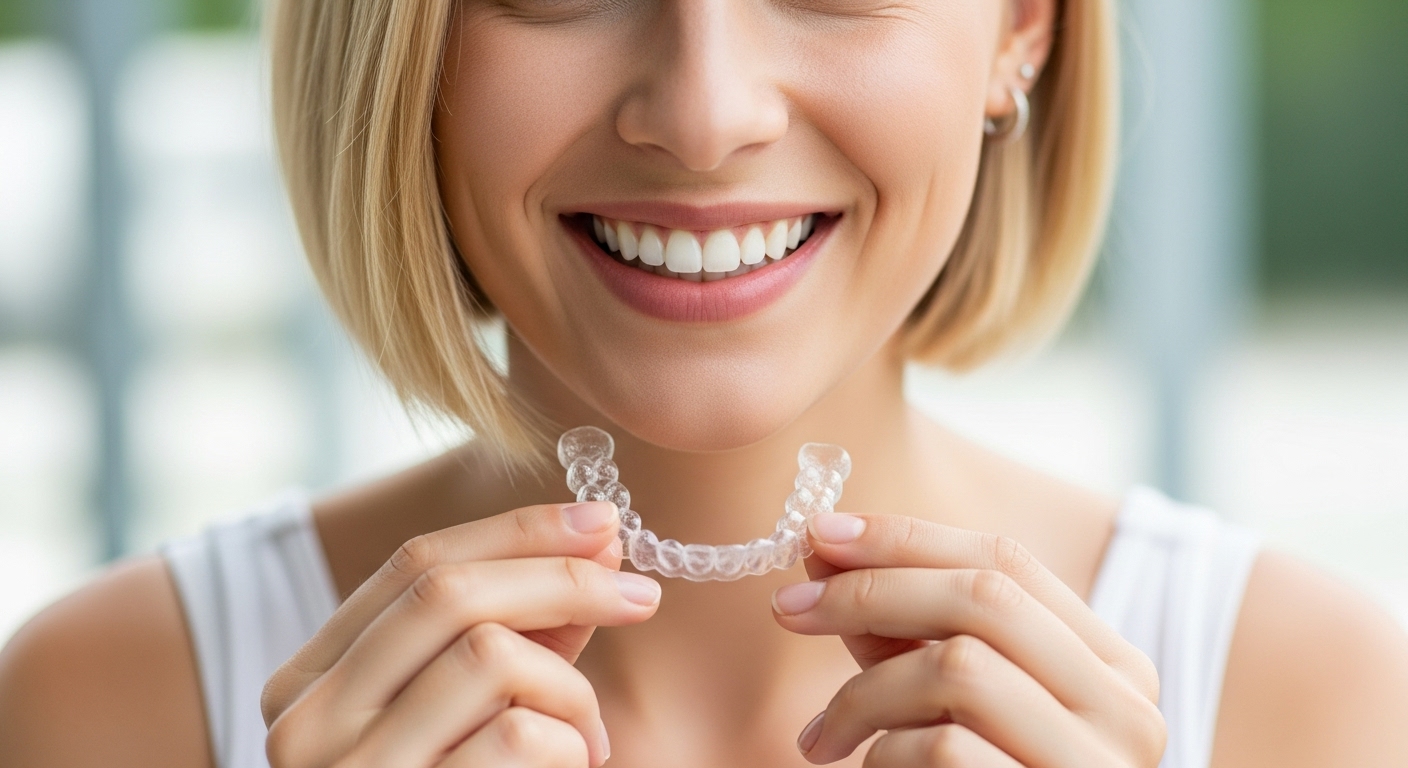
This revolutionary approach uses a series of clear, removable, custom-made aligners. Each aligner gradually moves teeth toward their final position. It's a very popular solution for its aesthetics and practicality, since you can remove the aligners to eat and brush your teeth.
What is the best option for you?
There is no universal "ideal" solution. The wisest choice depends on several criteria:
- The complexity of your case: Some severe orthodontic problems sometimes require a traditional appliance.
- Your budget: Costs can vary significantly between different treatment options.
- Your lifestyle: The discipline required to wear aligners 22 hours a day can be a determining factor.
- Your aesthetic requirements: Discretion is often the main criterion for adult patients.
The best approach is to consult an orthodontist who can evaluate your situation and discuss the pros and cons of each option with you.
Can you align teeth without an appliance?
This is a recurring question, but the answer is no. To move teeth, it is essential to apply controlled mechanical force, which only an orthodontic appliance (braces or aligners) can do. There is no "natural" method or miracle product for getting straight teeth. Aligners like Invisalign, although very different from braces, are a full-fledged orthodontic treatment.
Conclusion
Getting aligned teeth is an achievable goal that can transform a smile and boost self-confidence. From proven traditional solutions to modern technologies like Invisalign, the possibilities are numerous. The first step is to schedule a consultation to define a custom treatment plan toward your ideal smile.
Ready to start your Invisalign treatment?
Find a certified Invisalign orthodontist near you with our interactive map of orthodontists in Cannes and the French Riviera.
Find an orthodontist