Dental Filling: Everything You Need to Know
What is a dental filling?
The dental filling, more commonly called "filling", refers to a medical method used by dental surgeons to restore a tooth damaged by a cavity or by trauma. Cavities correspond to holes that are created in the teeth under the effect of the accumulation of dental plaque. This plaque is an adherent deposit, made up of bacteria, which forms on the surface of the teeth.
To prevent the infection from spreading and the tooth from being totally destroyed, the practitioner removes the decayed area and replaces it with an appropriate material in order to restore the tooth's shape and function.
Why does one need a dental filling?
When the bacteria present in the mouth generate acids that attack the enamel, this favours the appearance of cavities. Without management, these can lead to pain, infections and, in the most serious situations, the loss of the tooth. The dental filling therefore serves to stop the progression of the cavity and to preserve the tooth as well as the dental tissues against new deterioration.
How to identify the need for a dental filling?
In order to prevent dental problems, it is possible that you need a filling. Certain signals deserve to be observed attentively.
If pain or sharp sensitivity manifests itself when you eat or drink something sweet, hot or cold, it may indicate the presence of a cavity.
Pain that persists in the tooth is frequently the sign of an already advanced cavity; it can range from simple discomfort to marked pain, particularly when biting or chewing during meals.
Untreated cavities are often accompanied by bad breath or an unpleasant taste in the mouth. If the gum is affected by the infection, you may notice swelling, redness or gum bleeding.
What are the different materials used for dental fillings?
Dentists have several materials at their disposal to carry out a dental filling. Each presents its own advantages and limitations, and the choice takes into account both the location of the cavity, its degree of progression and the patient's preferences regarding the visibility of the filling.
We speak of inlays for fillings shaped inside the cusps (points) of the tooth and of onlays, sometimes designated as "partial crowns", for restorations that encompass one or more cusps.
Amalgams
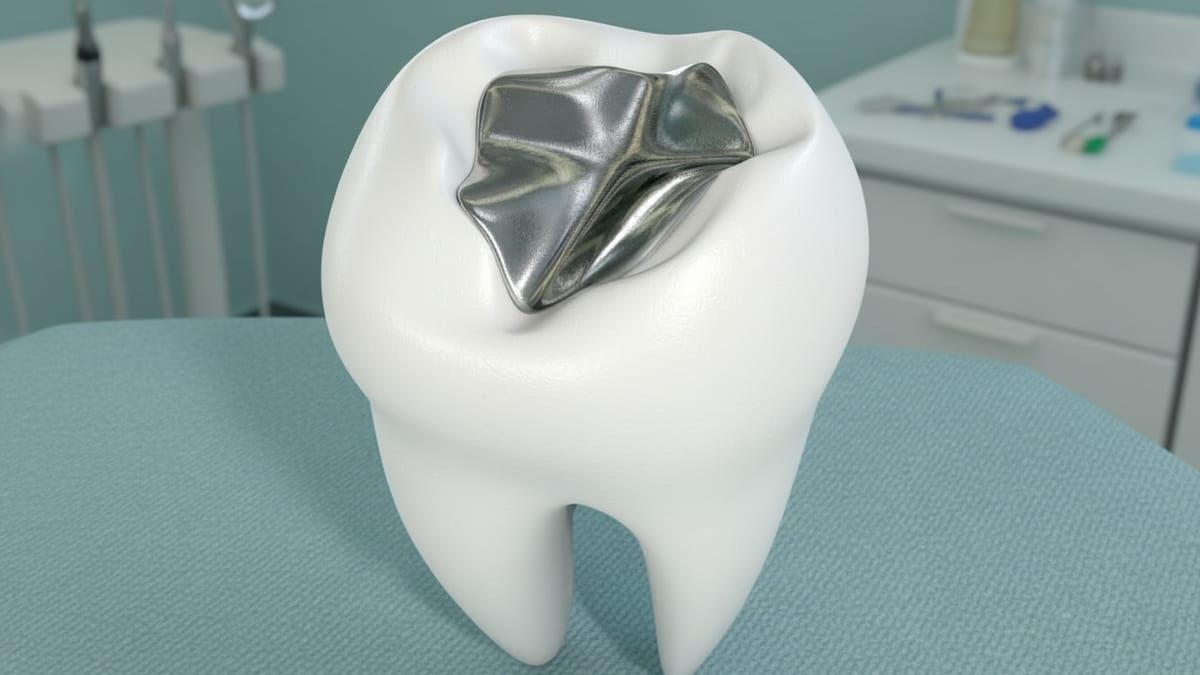
Dental amalgams combine several metals: mercury, silver, tin and copper. This material is distinguished by its durability and moderate cost. It has been used for many decades for dental fillings. However, due to its metallic shade, it remains less aesthetic and tends to be less and less used for visible teeth.
Composite resins
Composite resins are plastic materials enriched with glass particles. Their shade reproduces that of teeth, which makes them particularly suited to visible fillings. Even though they are less resistant than amalgams for large cavities, they offer sufficient solidity for both anterior and posterior teeth, while guaranteeing a very advantageous aesthetic result.
Gold
Gold fillings (inlays) are characterised by very great longevity and can last several decades. They however constitute the most expensive option and remain more visible on the teeth.
Porcelain
Also called an inlay, the porcelain filling blends harmoniously with the natural shade of the tooth. Very little sensitive to staining, these fillings are situated in a price range close to that of gold ones.
How does a dental filling proceed?
The dental filling corresponds to a rather simple and quick intervention, most often carried out during a single session. The dentist begins by numbing the area around the tooth in order to avoid any painful sensation during the treatment.
Once the area is anaesthetised, the practitioner uses a drill or a laser to remove the decayed part. The cavity is then carefully cleaned in order to eliminate the bacteria and residues.
The dental surgeon then selects the most appropriate type and material of filling (amalgam, resin, porcelain or gold) and places it in the cavity. To finish, he sculpts and polishes the filling so as to make it smooth and perfectly integrated into the natural tooth.
Precautions to take after a dental filling
After the placement of a filling, it is common to experience sensitivity to heat, cold or pressure. This discomfort generally fades within a few days. It is also preferable to avoid sticky or hard foods for a few days, the time needed for the filling to stabilise correctly.
It is recommended to maintain rigorous oral hygiene by brushing the teeth at least 2 times a day.
Finally, in case of dental pain, do not delay: quickly make an appointment with your dentist in Cannes to receive the necessary care.