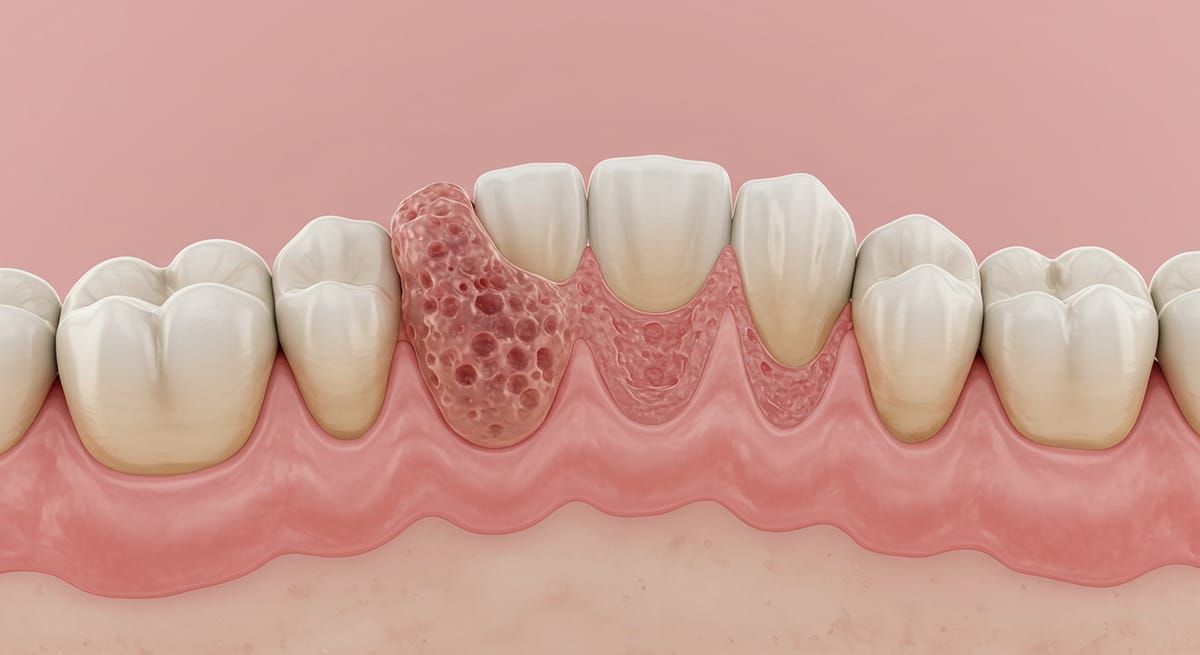
Dental Cysts: Origins and Treatment
The dental cyst takes the form of a tumour that appears in the jaw, usually at the level of a non-vital tooth.
What is a dental cyst?
The dental cyst — or granuloma — appears as a small, flexible sac filled with fluid, whose volume gradually increases. This growth results from the continuous production of the fluid it contains, which is why its removal is mandatory.
The growth generally appears under the root of a tooth, whether dead or apparently healthy. It may or may not be visible at the level of the gum or the jaw. Diagnosis is most often made by X-ray. The most common symptoms are:
- pain;
- an unusual bad breath;
- a fistula at the level of the mucous membrane (opening in the gum allowing the evacuation of pus).
Under what circumstances can this dental tumour form?
Two main origins can be distinguished:
- Infectious origin: the necrosis of a tooth, following an untreated cavity or a poorly performed root canal treatment, causes a bone infection responsible for the formation of a cyst attached to the dental root.
- Accidental cause: some tumours result from a jaw fracture or an oral impact that led to an unnoticed dental necrosis.
Congenital cysts, on the other hand, are most often linked to the development of teeth and maxillary bones.
What happens if a cyst forms in your jaw?
As long as its diameter remains less than 5 mm, this tumour causes no notable discomfort and may go unnoticed. Pain may, however, appear at the level of the tooth, jaws or gum as it develops. The tooth may then move or fall out for no apparent reason, and the discomfort caused can eventually interfere with eating.
Among the frequent complications, we find:
- the formation of abscesses;
- swelling of the jaw or gums;
- gum bleeding at the slightest impact.
How to treat a dental cyst?
The only effective treatment against this type of tumour is excision, that is, complete surgical removal. In certain cases, treating the underlying cause may be enough to cause it to disappear. The procedure requires precise expertise: if the practitioner merely pierces the pouch, it will fill up again. Any residue, however minimal, will cause the formation of a new tumour.
The treatment must always combine removal with that of the cause:
- extraction of the causal tooth;
- root canal treatment of a necrotic tooth or revision of a poorly performed treatment.
In the presence of an abscess, the infectious focus will first be treated with antibiotics before the removal of the cystic pouch and the possible extraction of the tooth. This operation, carried out under local anaesthesia, remains relatively simple.